Best Ingredients for Uneven Skin Tone: What Really Helps Brighten and Even Out Your Skin
Best Ingredients for Uneven Skin Tone Uneven skin tone is a common skincare concern that can show up as dark spots, acne marks, sunspots, or patches of discoloration. Sometimes, the skin looks dull in certain areas while other parts appear brighter. These changes can happen for several reasons, including sun exposure, hormonal fluctuations, inflammation, and the marks left behind by acne. The good news is that the right skincare ingredients can gradually improve the appearance of uneven skin tone without requiring an overly complicated routine.
When choosing skincare products, it helps to look beyond marketing claims such as “instant glow” or “brightening effect.” Some ingredients work by reducing excess melanin production, while others support skin renewal, calm inflammation, or protect the skin from further sun damage. Understanding these differences makes it easier to select products that suit your skin type and specific concerns.
In this guide, we will explore the best ingredients for uneven skin tone, explain how they work, and discuss how to use them safely. Whether you are dealing with post-acne marks, dullness, or stubborn dark patches, a consistent and well-planned skincare routine can help your complexion look more balanced over time.
What Causes Uneven Skin Tone?
Uneven skin tone develops when certain areas of the skin appear darker, redder, or less uniform than the surrounding skin. One of the main causes is hyperpigmentation, a condition in which the skin produces or retains excess melanin. Melanin is the natural pigment responsible for skin, hair, and eye color. When it accumulates unevenly, dark spots and patches may become visible.
Sun exposure is another major factor. Ultraviolet radiation can stimulate melanin production, making existing dark spots more noticeable and contributing to new discoloration. Even if your skin looks clear during winter or on cloudy days, regular exposure to sunlight can gradually affect its appearance. This is why daily sunscreen is an important part of any routine designed to improve uneven skin tone.
Inflammation can also leave discoloration behind. Acne, picking at blemishes, irritating skincare products, and certain skin conditions may trigger post-inflammatory hyperpigmentation. Hormonal changes can contribute to melasma, which often appears as brown or gray-brown patches on the cheeks, forehead, or upper lip. Identifying the likely cause helps you choose appropriate ingredients instead of trying several products without a clear plan.
1. Vitamin C for Brighter-Looking Skin
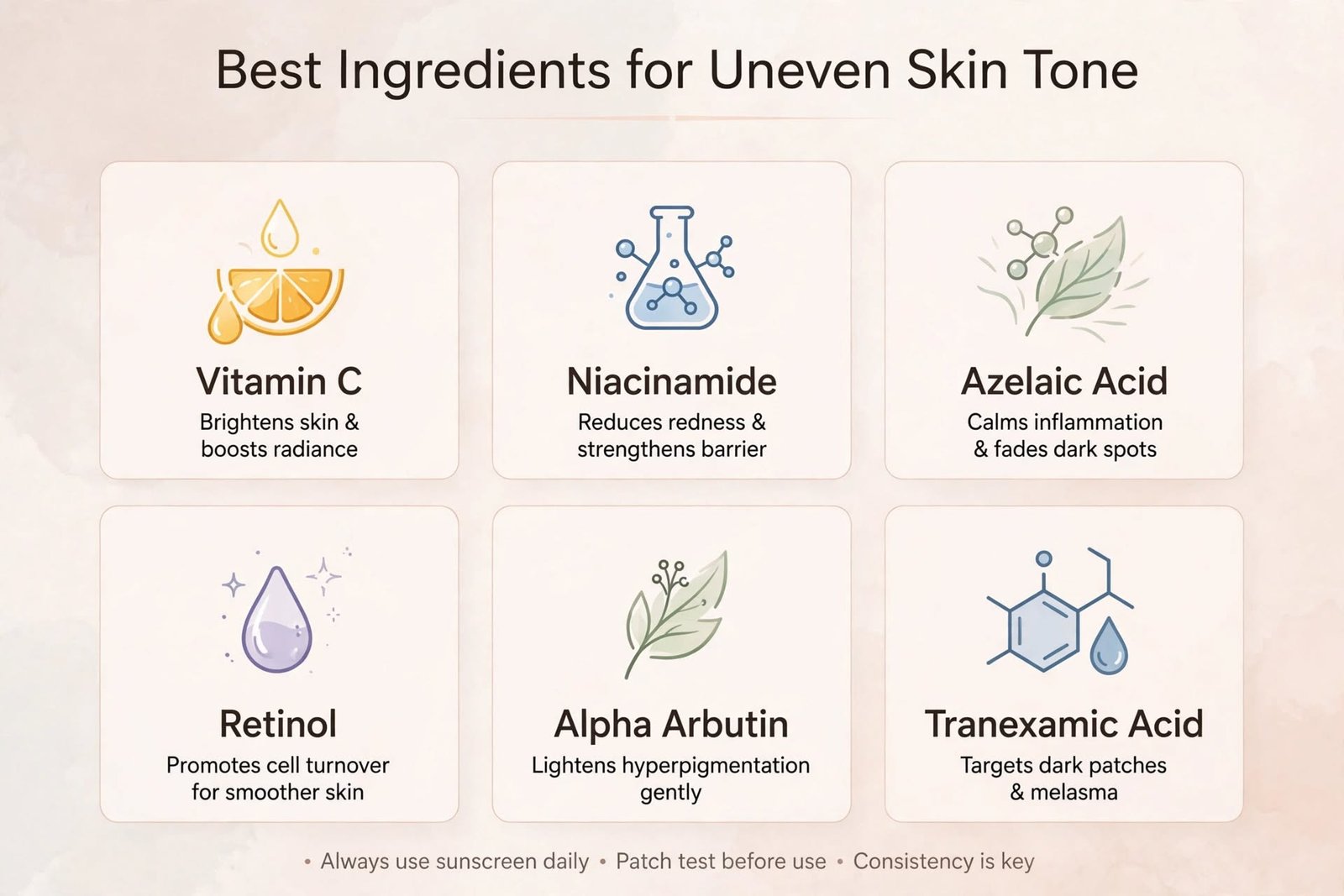
Vitamin C is one of the most popular skincare ingredients for improving the appearance of uneven skin tone. It is an antioxidant that helps protect the skin from oxidative stress caused by environmental factors. Certain forms of vitamin C can also interfere with steps involved in melanin production, making them useful in routines targeting dark spots and dullness.
There are different forms of vitamin C in skincare products. L-ascorbic acid is the best-known form and has been widely studied, although it can irritate sensitive skin, particularly at higher concentrations. Other forms, such as sodium ascorbyl phosphate and magnesium ascorbyl phosphate, may be suitable alternatives depending on the formulation. The effectiveness of a product depends on more than the ingredient name alone; concentration, stability, packaging, and overall formulation matter too.
Vitamin C is commonly used in the morning after cleansing and before moisturizer and sunscreen. If you are new to it, begin with a gentle formula and introduce it gradually. Some people notice a brighter appearance within several weeks, while more visible changes in dark spots may take longer. Vitamin C can complement sunscreen, but it does not replace it.
2. Niacinamide for More Even-Looking Skin
Niacinamide, also known as vitamin B3, is a versatile ingredient that can help improve the appearance of uneven skin tone while supporting the skin barrier. It may reduce the transfer of melanin-containing structures from pigment-producing cells to surrounding skin cells. With consistent use, this action may help certain dark marks become less noticeable.
Another advantage of niacinamide is that it supports moisture retention and helps maintain a healthy skin barrier. This is particularly useful for people whose skin becomes dry or irritated when using active ingredients. A stronger skin barrier can make a skincare routine easier to tolerate, especially when it includes products designed to address discoloration.
Niacinamide is available in moisturizers, serums, and other leave-on products. Concentrations around 2% to 5% are reasonable starting points for many people, although individual tolerance varies. Higher concentrations are not automatically better and may cause irritation in some users. It can generally be combined with ingredients such as hyaluronic acid, vitamin C, and retinoids, provided the complete routine is suitable for your skin.
3. Azelaic Acid for Dark Marks and Redness
Azelaic acid is a useful ingredient for people who experience uneven skin tone alongside acne or persistent redness. It has anti-inflammatory properties and can help reduce the appearance of certain forms of hyperpigmentation. It also has activity against acne-related processes, making it a practical option when blemishes and the marks they leave behind occur together.
One reason azelaic acid stands out is that it can address more than one concern without necessarily requiring several separate products. It may be recommended for acne-related discoloration and can also be used in the management of melasma. However, the results depend on the underlying condition, product strength, and how consistently the treatment is used.
Azelaic acid is available in different formulations and strengths, including cosmetic products and prescription treatments. People with sensitive skin should introduce it gradually because mild stinging, itching, dryness, or irritation can occur. Avoid applying it to broken or severely irritated skin, and follow the product instructions or a healthcare professional’s advice. It is particularly worth considering if your uneven tone is associated with acne marks.
4. Retinol for Skin Renewal
Retinol is a vitamin A derivative that supports skin-cell turnover and can improve the appearance of uneven texture, fine lines, and some forms of discoloration over time. By influencing how skin cells develop and shed, retinoids may help reduce the visibility of certain dark marks. They can also help manage acne, which may reduce the formation of new post-acne spots.
However, retinol is not an overnight solution. It may take several weeks or months to see meaningful improvement, and the initial adjustment period can involve dryness, peeling, redness, or irritation. Excessive use can damage the skin barrier and potentially worsen discoloration, particularly in people prone to post-inflammatory hyperpigmentation. Starting with a low-strength product and using it only a few nights per week can help improve tolerance.
Retinol is usually applied in the evening to clean, dry skin, followed by moisturizer. Avoid starting it at the same time as several other strong active ingredients. Retinoids should generally be avoided during pregnancy or when trying to conceive unless your healthcare professional provides specific guidance; prescription retinoids are not recommended during pregnancy. If you have eczema, very sensitive skin, or persistent irritation, seek professional advice before introducing one.
5. Alpha Arbutin for the Appearance of Dark Spots
Alpha arbutin is a cosmetic ingredient used in products designed to improve the appearance of dark spots and uneven pigmentation. It works by inhibiting tyrosinase, an enzyme involved in melanin production. Because of this mechanism, it is commonly included in serums formulated for post-acne marks, sun-related discoloration, and an uneven-looking complexion.
Unlike strong exfoliating acids, alpha arbutin is generally intended to target pigmentation without relying on peeling the skin. That can make it appealing to people who want a straightforward brightening product. However, research on topical alpha arbutin is less extensive than the evidence supporting some established treatments, and results can vary considerably from one formulation to another.
Alpha arbutin is often used once or twice daily, depending on the product instructions and individual tolerance. It can usually fit into a routine with niacinamide or a moisturizer. As with other brightening ingredients, daily sunscreen remains important. Without sun protection, existing spots may darken again, limiting the improvement you achieve from your skincare products.
6. Glycolic Acid for Dullness and Uneven Texture
Glycolic acid is an alpha hydroxy acid (AHA) that helps loosen the bonds between dead skin cells on the skin’s surface. This exfoliating action can improve the appearance of dullness and rough texture. With appropriate use, it may also help certain superficial dark marks look less noticeable by supporting the removal of surface skin cells.
Because glycolic acid has a relatively small molecular size, it can penetrate the skin effectively, but this may also make it irritating for some people. Products with higher concentrations or frequent application can cause burning, dryness, redness, and peeling. These effects are not signs that the product is working better; irritation can make pigmentation concerns worse.
If you choose glycolic acid, begin with a low-strength product and use it infrequently, following the label directions. Avoid using it on irritated skin, and be cautious about combining it with retinol or other exfoliating acids until you understand your skin’s tolerance. AHAs can increase sensitivity to sunlight, so consistent broad-spectrum sunscreen is essential.
7. Tranexamic Acid for Stubborn Pigmentation
Tranexamic acid has become increasingly popular in skincare products formulated for persistent discoloration, particularly melasma and uneven pigmentation. It appears to influence several biological pathways involved in pigment formation rather than acting solely through one mechanism. Topical formulations may help improve the appearance of stubborn dark patches when used consistently.
Melasma can be challenging to manage because it is influenced by sunlight, visible light, hormones, and individual susceptibility. Tranexamic acid may be useful as part of a broader treatment approach, but it should not be considered a guaranteed cure. Evidence for topical products is still developing, and the results depend on the cause and severity of pigmentation.
Topical tranexamic acid is generally used according to the product’s instructions and may be combined with moisturizer and sunscreen. Oral tranexamic acid is a different treatment that should never be started for cosmetic pigmentation without medical supervision because it can carry serious risks, including blood clots in susceptible individuals. For persistent or spreading patches, a dermatologist can help identify the cause and recommend a suitable treatment plan.
8. Licorice Root Extract for Gentle Brightening
Licorice root extract is a plant-derived ingredient found in some products designed for uneven skin tone and sensitive skin. Certain compounds in licorice, including glabridin, have been studied for their potential to influence pigmentation and reduce inflammation. This makes licorice extract an appealing ingredient in formulations aimed at improving the appearance of dark marks.
It is often included in moisturizers and serums alongside other brightening ingredients. Some people prefer products containing licorice extract because they want a gentler-feeling alternative to stronger exfoliating treatments. However, the effectiveness depends on the specific extract, its concentration, and the formulation. Evidence is more limited than for some better-established dermatological treatments.
Licorice root extract should not be assumed to be irritation-free simply because it is plant-derived. Any cosmetic ingredient can trigger sensitivity in some individuals. Patch-test new products and discontinue use if you experience persistent redness, itching, or swelling. For more noticeable pigmentation, licorice extract may work best as a supporting ingredient rather than the only treatment.
9. Hyaluronic Acid for Hydration and Skin Comfort
Hyaluronic acid is best known for attracting and holding water, helping the skin feel hydrated and appear smoother. It does not directly target melanin production in the same way as certain brightening ingredients. Nevertheless, hydration is an important part of a routine for uneven skin tone because dry, flaky skin can make texture and discoloration appear more noticeable.
Well-hydrated skin may also tolerate active ingredients more comfortably. If you are using retinol, azelaic acid, or exfoliating acids, a moisturizer containing hyaluronic acid can help support a more comfortable routine. Many formulations combine it with glycerin, ceramides, or other moisturizing ingredients for additional barrier support.
Hyaluronic acid can generally be used morning and evening. Apply it according to the product directions and follow with moisturizer when needed to reduce moisture loss. It is useful to remember that hydration improves the skin’s overall appearance, but it will not necessarily fade established dark spots on its own. Pairing hydration with an appropriate pigmentation treatment and sunscreen offers a more complete approach.
10. Sunscreen: The Most Important Ingredient for Preventing Further Discoloration
Sunscreen deserves a central place in any routine for uneven skin tone. Ultraviolet radiation can stimulate pigment production and darken existing marks, making it harder for other skincare ingredients to deliver visible results. Even an effective brightening serum may provide limited improvement if your skin is repeatedly exposed to unprotected sunlight.
Choose a broad-spectrum sunscreen with SPF 30 or higher. Apply enough to cover the face, ears, neck, and other exposed areas, and reapply approximately every two hours when outdoors, as well as after swimming or heavy sweating. Daily protection is valuable even when you spend much of your time indoors near bright windows, although the amount of exposure varies by environment.
For people prone to melasma or persistent pigmentation, a tinted sunscreen containing iron oxides may provide additional protection against visible light. This can be particularly helpful for some deeper skin tones, where visible-light exposure may contribute to worsening pigmentation. Sunscreen is not a treatment that instantly removes existing dark spots, but it helps prevent them from becoming more pronounced and supports the results of other ingredients.