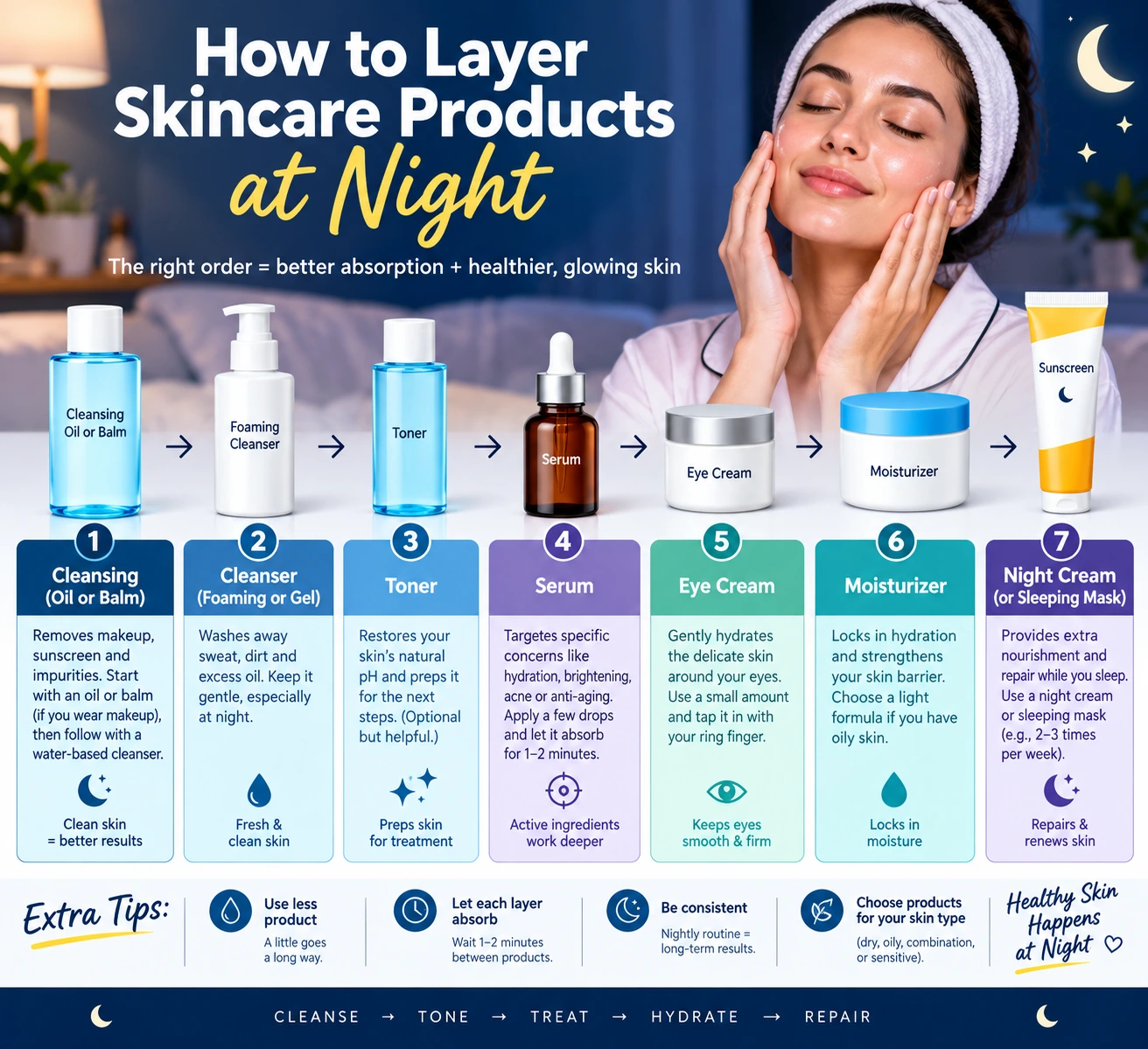
How to Layer Skincare Products at Night: A Simple Step-by-Step Guide
How to Layer Skincare Products at Night Your nighttime skincare routine does not need to be complicated to work well. The key is knowing which products to apply first, which ingredients work well together, and how to give your skin the care it needs without overwhelming it. A well-planned evening routine can help remove daily buildup, maintain hydration, and support the skin’s natural renewal process.
If you have ever wondered whether serum should go before moisturizer or whether you need to use a toner every night, you are not alone. Skincare products often come with different instructions, and combining too many active ingredients can sometimes lead to dryness, redness, or irritation.
In this guide, you will learn how to layer skincare products at night in the correct order, how to choose products for your skin type, and how to avoid common mistakes. Whether you have oily, dry, combination, or sensitive skin, the goal is to build a routine that feels comfortable and is easy to maintain.
Why the Order of Your Nighttime Skincare Routine Matters
The order in which you apply skincare products can affect how comfortably they sit on your skin and how effectively you follow the instructions for each formula. As a general rule, skincare routines move from cleansing to treatment products and then to moisturizing. This approach helps remove impurities first, allows targeted products to be applied to clean skin, and finishes with hydration.
Using products in a random order can make your routine less practical. For example, applying a rich cream before a lightweight serum may make it harder for the serum to spread evenly. However, the correct order is not determined by texture alone. Product instructions, active ingredients, and your skin’s tolerance also matter.
It is equally important to remember that more products do not automatically produce better results. A simple routine with a gentle cleanser, one suitable treatment, and a moisturizer may be more useful than a ten-step routine that causes irritation. Start with the essentials and add other products only when you have a clear reason to use them.
Step 1: Remove Makeup and Sunscreen
The first step in your nighttime skincare routine is removing makeup, sunscreen, and the buildup that accumulates throughout the day. Leaving these products on overnight can make your skin feel uncomfortable and may interfere with proper cleansing. Choose a removal method that works with your skin type and the products you wear.
If you use waterproof mascara, long-wear makeup, or water-resistant sunscreen, a cleansing oil or balm can help dissolve these formulas. Massage the product gently over dry skin according to its instructions, then rinse or emulsify it as directed. Avoid rubbing your eyes or pulling at delicate skin, especially when removing stubborn makeup.
You do not necessarily need a double cleanse every evening. If you wear heavy makeup or water-resistant sunscreen, following an oil-based cleanser with a gentle water-based cleanser may help remove residue. If you do not wear makeup and your first cleanser leaves your skin clean and comfortable, one thorough cleanse may be enough.
Step 2: Cleanse Your Face With a Gentle Cleanser
After removing makeup and sunscreen, cleanse your face with a product suited to your skin type. A gentle cleanser helps remove remaining dirt, sweat, excess oil, and residue without unnecessarily stripping the skin. Use lukewarm water rather than hot water, which can contribute to dryness and irritation.
People with oily or acne-prone skin may prefer a lightweight gel cleanser, while those with dry skin may feel more comfortable using a creamy or lotion-based formula. Sensitive skin often benefits from fragrance-free products with a short, uncomplicated ingredient list. The best cleanser is one that leaves your face feeling clean without tightness, burning, or excessive dryness.
Apply the cleanser using your fingertips and follow the product’s directions. There is no need to scrub aggressively or use a rough washcloth. Rinse thoroughly and pat your face dry with a clean, soft towel. If you are introducing exfoliating cleansers or acne treatments, pay attention to how frequently they should be used to avoid irritating your skin.
Step 3: Apply Toner or an Essence if Needed
Toner is an optional step rather than a requirement for everyone. Modern toners come in different formulas, including hydrating products, exfoliating liquids, and treatments designed for particular skin concerns. A hydrating toner may be useful if your skin feels dry after cleansing, but you can skip this step if your cleanser and moisturizer already meet your needs.
If you choose a hydrating toner or essence, apply it according to the label, usually after cleansing and before serums. Ingredients such as glycerin and hyaluronic acid can help attract and retain moisture. These products can be particularly helpful when your skin feels dehydrated, although the benefits depend on the overall formula and how you use it.
Be more cautious with toners containing exfoliating acids, such as glycolic acid, lactic acid, or salicylic acid. These products can help address rough texture or clogged pores, but frequent use may cause irritation. Avoid combining several exfoliating products in the same routine when you are starting out, and do not assume that a tingling sensation means a product is working better.
Step 4: Apply Your Treatment Serum
Serums are concentrated skincare products designed to target particular concerns, including dehydration, uneven skin tone, fine lines, or blemishes. Once cleansing and any optional toner are complete, apply your chosen serum according to its instructions. In many routines, a lightweight serum comes before a thicker cream, but the formula and product directions should guide your decision.
For hydration, a serum containing hyaluronic acid or glycerin may help your skin retain moisture. Niacinamide is another popular ingredient that can support the skin barrier and improve the appearance of uneven tone or excess oil for some people. Vitamin C is often used to address uneven pigmentation and protect against oxidative stress, although it is more commonly included in morning routines as part of a daytime antioxidant regimen.
Choose a serum based on your main concern instead of applying several products simply because they are popular. If you are dealing with acne, a product containing an appropriate acne-fighting ingredient may be more relevant than a collection of unrelated serums. Introduce one new product at a time so that you can identify which formulas suit your skin and which ones cause problems.
Step 5: Use Retinol or Another Targeted Treatment
If your routine includes retinol, retinal, a prescribed retinoid, or another targeted treatment, this is an important stage to plan carefully. Retinoids can help improve acne and certain signs of photoaging, but they may also cause dryness, peeling, redness, or irritation, particularly when first introduced. Follow the instructions supplied with your product or provided by your healthcare professional.
For many over-the-counter retinol products, nighttime application is recommended. Start with a low-strength product and use it less frequently at first, such as on two evenings per week, if the label allows. Increase frequency gradually only if your skin tolerates it. Some people with sensitive skin benefit from applying moisturizer before and after retinol to reduce irritation, although the best method depends on the specific formula.
Avoid starting retinol at the same time as multiple exfoliating acids, strong acne treatments, or other potentially irritating products. Combining active ingredients is not always harmful, but the risk of irritation can increase when several treatments are introduced together. If you are pregnant or planning pregnancy, seek advice from your healthcare professional and avoid retinoids during pregnancy. Prescription treatments should always be used according to professional guidance.
Step 6: Apply Eye Cream if You Want to Use One
Eye cream is an optional step for people who want extra hydration around the eyes. The skin in this area is delicate, and a suitable moisturizer may help reduce the appearance of dryness and make fine lines look less noticeable. However, you do not necessarily need a separate eye product if your regular moisturizer is suitable for the area.
If you use eye cream, apply a small amount according to its instructions. Gently tap it around the orbital bone with your ring finger rather than pulling or rubbing the skin. Keep the product away from the eyes themselves, and stop using it if it causes persistent stinging, redness, or watering.
Choose an eye product based on your actual concern. A moisturizing formula may be useful for dryness, while certain ingredients can target the appearance of puffiness or uneven tone. Keep expectations realistic: eye creams can improve the appearance of some concerns, but they cannot completely eliminate genetic dark circles, deep wrinkles, or every cause of under-eye puffiness.
Step 7: Seal in Moisture With a Face Moisturizer
Moisturizer is an important part of most nighttime skincare routines because it helps reduce water loss and supports the skin barrier. After applying your treatment products, use a moisturizer suited to your skin type. This final hydration step can make your routine more comfortable, especially if you use ingredients that sometimes cause dryness.
For dry skin, a richer cream containing ingredients such as ceramides, glycerin, or petrolatum may be helpful. People with oily or acne-prone skin may prefer a lighter lotion or gel-cream that feels comfortable without leaving a heavy residue. Combination skin may benefit from a medium-weight moisturizer or a slightly richer product on dry areas.
Apply the moisturizer gently and evenly, following the product instructions. You do not need to use a large amount or leave your face feeling greasy. If your skin feels tight after your routine, consider whether your cleanser or treatment is too harsh rather than simply adding more layers. Persistent dryness or burning can be a sign that you need to reduce active ingredients or simplify your routine.
Step 8: Add Face Oil or an Occlusive Product Only if Needed
Face oil is an optional addition, particularly for people whose skin remains dry even after moisturizing. Depending on its ingredients, a face oil may help soften the skin and reduce moisture loss. However, oils are not essential for everyone, and they do not replace the water-attracting and barrier-supporting ingredients found in many moisturizers.
If you want to use a facial oil, apply it in a way that works with the product’s directions. Some people prefer to apply a few drops over moisturizer, while others use a lightweight oil earlier in the routine. There is no universal rule that every oil must always be the last product, because formulations vary and some oils are designed to be used differently.
An occlusive product, such as a thin layer of petrolatum, can help reduce water loss in particularly dry areas. This technique is sometimes called slugging. It may not suit everyone, especially if a heavy layer feels uncomfortable or worsens breakouts. Be cautious about applying an occlusive layer over strong active treatments unless you know that combination is appropriate, because it may increase irritation from some products.
The Correct Order for Layering Skincare Products at Night
The following table provides a practical starting point for an evening routine. You do not need every step, and optional products should be included only when they meet your skin’s needs.
| Order | Product | Main purpose |
|---|---|---|
| 1 | Makeup remover or cleansing balm | Dissolves makeup and sunscreen when needed |
| 2 | Gentle facial cleanser | Removes dirt, sweat, and residue |
| 3 | Hydrating toner or essence | Adds optional hydration |
| 4 | Treatment serum | Targets specific skin concerns |
| 5 | Retinol or other targeted treatment | Addresses concerns such as acne or signs of aging |
| 6 | Eye cream | Provides optional hydration around the eyes |
| 7 | Face moisturizer | Supports the skin barrier and reduces water loss |
| 8 | Face oil or occlusive | Provides optional additional moisture protection |
The exact order can change depending on the product. For example, some acne treatments are designed to be applied directly after cleansing, while certain prescription products have specific application instructions. Always follow the product label or your prescriber’s guidance when it differs from a general routine.
A useful rule is to avoid adding several new products at once. Give your skin time to adjust, observe how it responds, and make changes gradually. Consistency and tolerability are more important than following the longest possible routine.
How to Layer Skincare Products for Different Skin Types
For oily skin: Choose a gentle cleanser and a lightweight moisturizer. If you experience clogged pores or acne, an appropriate treatment such as salicylic acid may be helpful when used according to its directions. Avoid washing your face repeatedly or skipping moisturizer simply because your skin produces excess oil.
For dry skin: Focus on gentle cleansing, hydration, and a moisturizer that supports the skin barrier. Ingredients such as glycerin, ceramides, and petrolatum can be useful depending on the formula. Limit harsh exfoliation and avoid using hot water or multiple drying treatments in the same evening.
For combination skin: Use products that balance comfort and hydration without making oily areas feel heavy. A lightweight moisturizer may work across the whole face, with a richer cream applied to dry patches if needed. You can also adjust treatment frequency based on how different areas of your face respond.
For sensitive skin: Keep your routine simple and prioritize fragrance-free products that your skin tolerates. Introduce active ingredients slowly, and test new products on a small area before applying them widely. If you develop persistent burning, swelling, or a rash, discontinue the suspected product and seek medical advice when appropriate.
Common Mistakes to Avoid When Layering Skincare Products
One common mistake is using too many active ingredients at the same time. Retinol, exfoliating acids, benzoyl peroxide, and other treatments can each serve a purpose, but combining several without a plan may irritate the skin. Start with one targeted treatment and add other ingredients only when there is a clear need and the combination is appropriate.
Another mistake is assuming that expensive products always work better. A simple, well-formulated cleanser and moisturizer can be more useful than a collection of costly products that do not match your skin type. Read ingredient lists, follow instructions, and pay attention to how your skin feels instead of relying entirely on marketing claims.
Finally, do not expect overnight results. Hydration may improve how your skin feels relatively quickly, but concerns such as acne, dark spots, and uneven texture often take weeks or longer to improve. Avoid changing your entire routine every few days, and remember that sunscreen remains important the following morning, particularly when you use ingredients that can make your skin more sensitive to sunlight.
How Long Should You Wait Between Skincare Layers?
There is no universal waiting time that applies to every skincare product. Many lightweight products can be layered once the previous application has spread evenly, while certain treatments may require specific instructions about when and how to apply them. You generally do not need to wait several minutes between every step unless the product directions recommend doing so.
If a product pills, rolls off the skin, or feels uncomfortable when another layer is added, try using smaller amounts and allowing the previous product to settle. You can also simplify the routine to identify which combination is causing the problem. Applying more product does not necessarily improve its performance.
For retinoids, exfoliating treatments, and prescription products, follow the directions rather than relying on a fixed waiting-time rule. If you are unsure how to combine a particular treatment with other products, ask a pharmacist, dermatologist, or prescribing clinician for advice.
A Simple Nighttime Skincare Routine for Beginners
If you are new to skincare, begin with three basic steps: cleanse, treat if needed, and moisturize. This gives you a practical foundation without requiring numerous products. Choose formulas that suit your skin type, and avoid introducing several new active ingredients during the same week.
Once your skin is comfortable with the basic routine, you can add a hydrating serum or a targeted treatment for a specific concern. For example, someone dealing with dehydration may benefit from a hydrating serum, while someone treating acne may need a suitable acne product. The best additions depend on your skin’s needs, not on how many steps appear in a popular skincare routine.
Make the routine easy enough to follow consistently. Remove makeup and sunscreen before bed, use products as directed, and pay attention to signs of irritation. In the morning, cleanse as needed, moisturize, and apply broad-spectrum sunscreen with SPF 30 or higher. This helps protect your skin during the day and complements your nighttime routine.
Google E-E-A-T
Google’s E-E-A-T framework stands for Experience, Expertise, Authoritativeness, and Trustworthiness. It is a way to think about the quality and credibility of helpful content, rather than a simple score that guarantees search rankings.
| E-E-A-T element | How this article addresses it |
|---|---|
| Experience | Provides practical guidance for building and maintaining a nighttime skincare routine |
| Expertise | Explains product order, ingredient considerations, and skin-type differences |
| Authoritativeness | Encourages readers to follow product labels and seek qualified professional guidance when needed |
| Trustworthiness | Avoids promising instant results and explains that products and skin responses vary |
For stronger editorial credibility, a publisher should have skincare and medical claims reviewed by a suitably qualified professional where appropriate. The author should also verify product-specific recommendations against reliable sources before publication.
Nighttime Skincare Layering at a Glance
| Data point | Practical guidance |
|---|---|
| Essential starting steps | Cleanser and moisturizer |
| Optional hydration step | Toner, essence, or hydrating serum |
| Targeted treatment | Select according to your skin concern |
| Retinol introduction | Start slowly and follow product directions |
| Moisturizer purpose | Supports the skin barrier and reduces water loss |
| Face oil | Optional; depends on skin needs and formula |
| Expected results | Vary by product, concern, and consistency |
| Morning protection | Broad-spectrum sunscreen, SPF 30 or higher |
| Sensitive skin approach | Introduce products gradually and avoid known irritants |
| Professional advice | Recommended for persistent reactions or questions about prescription treatments |
Conclusion
Learning how to layer skincare products at night is mostly about following a sensible order and choosing products that suit your skin. Start by removing makeup and sunscreen when necessary, cleanse gently, apply suitable treatment products, and finish with moisturizer. Toners, eye creams, face oils, and other extras can be useful, but none needs to be included automatically.
Keep your routine consistent, introduce new ingredients gradually, and avoid combining too many potentially irritating treatments. If a product causes persistent discomfort, stop using it and seek professional advice when necessary. With a thoughtful approach, your nighttime skincare routine can remain simple, comfortable, and easier to maintain over time.